
Player · RUGBY BIOGRAPHY
Tom Ellison
1888–89 tour; captain to Australia in 1893
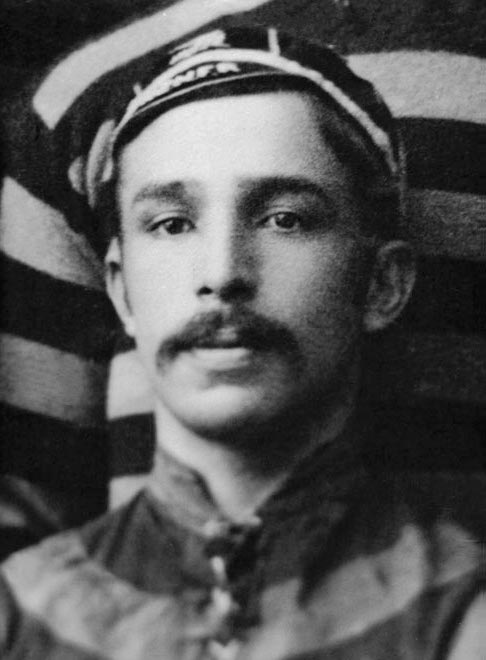
Historical rugby photograph · archive
Photo credit
Unknown authorUnknown author · Original photograph · Public domain. Display framing adjusted.THE JOURNEY
From local roots to the wider game
A club rugby idea can travel a long way. At Pōneke, Tom Ellison developed the wing-forward role to protect the delivery of the ball from the scrum. The position spread through Wellington and New Zealand, shaping the way the national game was played until the eight-man scrum replaced that system in 1932.
Thomas Rangiwāhia Ellison, also known as Tāmati Erihana, came from Ōtākou. His published whakapapa connects Ngāi Tahu and Te Āti Awa. He learned rugby in his community before attending Te Aute College, then joined Pōneke in 1885 and became a Wellington representative. His movement between forward, wing and halfback roles is part of the record of a player who thought closely about how the game worked.
The overseas test of that ability came with the Native team’s 1888–89 tour of Britain and Australia. The touring side played 107 matches in 54 weeks. Ellison finished as its second-highest points scorer, a performance within a schedule that placed enormous demands on the players. In 1893 he captained New Zealand to Australia.
Before that tour, he proposed the black jersey with a silver fern as part of the national uniform. His influence also reached readers: The Art of Rugby Football, published in 1902, was an early coaching manual. Beyond sport, Ellison worked as a lawyer and took an active interest in Māori land grievances. His story is about more than proposing a famous jersey. It connects a local club’s tactical experiment with national leadership, writing and a life of service beyond the field.
Club connections
Published records connect Tom Ellison with Poneke Football Club Inc. Explore the club profiles for the wider community story and sourced representative rolls.
A documented club connection does not always mean someone’s first club, junior club or club at national selection. Schools, provincial sides, national teams and professional clubs are distinct stages.
Whakapapa & identity
Ngāi Tahu · Te Āti Awa
Affiliations follow the published sources below; unrecorded iwi detail is left open.
Sources & further reading
Follow the original organisations, interviews and records behind this biography.
- Club, whakapapa and tours ↗
- NZ History: playing innovation, national captaincy and writing ↗
- New Zealand Rugby Museum: 1893 uniform resolution ↗
Career details reflect the dated sources above. This is a sourced overview, not a live squad list.
Suggest a sourced correctionMore people. More pathways.

Player · Ireland
James Lowe
From Nelson club grounds to the green jersey of Ireland.
Ngāpuhi · Ngāi Te Rangi
Read biography & club connections ↗
Player · Fiji
Deacon Manu
Taranaki roots. A Māori representative. Fiji’s World Cup captain.
Taranaki
Read biography & club connections ↗
Player · Japan
Derek Carpenter
Mid Northern to Japan’s national jersey, with Ngāti Wai roots.
Ngāti Wai
Read biography & club connections ↗